Court Records in Sacramento County – Fast, Accurate Search lets anyone needing reliable case information find exactly what they need without endless scrolling. By tapping the official Sacramento County court record database, users can pull up public court records online, whether they are looking for criminal court records, civil case files, or family court documents. The system supports a Sacramento County court record lookup by party name, case number, filing date, or even by specific court, making the Sacramento County court records search intuitive for both legal professionals and everyday citizens. When you enter a name or case number, the platform instantly displays case status, disposition, and any related motions or judgments, clearing common frustrations like missing documents or outdated information. This immediate access helps you verify case details, track case history, and understand court proceedings without the delays of a clerk’s office request.
Court Records in Sacramento County – Fast, Accurate Search also offers a comprehensive Sacramento County court case search that includes sealed records restrictions, juvenile case limits, and certified copy requests. Whether you need a court case search for a recent filing, a case lookup by party name, or a detailed case record by filing date, the portal delivers official court records with verified accuracy. Users can quickly differentiate between court records versus docket entries, ensuring they retrieve the exact documents such as complaints, petitions, motions, orders, and judgments. This streamlined approach eliminates common search problems like incorrect party names or wrong jurisdiction, providing a trustworthy source for all Sacramento County public court records needs.
How to Search Sacramento County Court Records
You can find Sacramento County Court Records through the official Superior Court of California, County of Sacramento online case search portal. This free tool lets you view public case details, party names, filing dates, and case status without creating an account. The portal covers criminal, including civil court records, civil, family, probate, and traffic cases filed in Sacramento County courts, and you can pull up records from your desktop or mobile device any time of day. The system draws directly from the clerk’s office database, so you see the most current details available.
Official Search Portal: https://www.saccourt.ca.gov/online-services/case-search
Steps to Search
- Visit the Sacramento Superior Court case search portal at the URL listed above.
- Choose how you want to search: by party name, case number, filing date, court, or case type.
- Type your search terms in the right field. Use full last names for best results.
- Click the search button to view matching cases.
- Select a case to see the full record, including parties, dates, hearings, and documents.
Search by Party Name
A party name search works when you know the full legal name of a person or business involved in a case. Type the last name first, then the first name, and narrow your results by adding a middle name or date of birth if known. The system displays all cases where that party appears as a plaintiff, defendant, petitioner, or respondent. You can click any case to view the full record and document list. This method works best for criminal, civil, and family law cases in Sacramento County.
Search by Case Number
A case number search gives you the fastest and most direct path to one specific record. Each case filed in Sacramento County receives a unique number, often starting with a year code, case type code, and sequence number. Type the full case number into the search field with no dashes or spaces. The portal will pull up that case right away, showing the judge, court location, filing date, and all related events. Use this method when you already have the case number from a lawyer, court notice, or prior search.
Search by Filing Date
A filing date search helps when you know when a case was opened but not the full case number. Pick a start date and end date, and the system shows all cases filed in that window. You can also combine the date range with a case type filter to narrow results. This method is useful for legal research, background checks, and tracking new filings in a specific court. The portal lists cases in date order, with the newest filings at the top.
Search by Court
Sacramento County operates several court locations, each handling different case types. The search by court option lets you limit results to one specific courthouse, such as the Gordon D. Schaber Courthouse or the Carol Miller Justice Center. Pick the court from the dropdown menu, add a party name or date range if you want, and run the search. This helps you focus on cases heard at a single location and avoids cross-court results that may confuse your search.
Search by Case Type
The case type filter narrows your search to a specific legal category, such as criminal, civil, family, probate, traffic, or small claims. Select the case type from the menu, add at least one more search term, and submit. The portal then displays only cases within that category. This method saves time when you need to find a specific type of case, such as a felony filing or a divorce petition. You can also use the case type filter to skip cases that are not relevant to your search.
Details Needed for a Court Records Search
Before you start your search, gather a few key facts to get the best results. Having the right details on hand helps you avoid empty results and speeds up the lookup. The most useful items include:
- Full legal name of a party (last, first, middle)
- Case number, if you have one
- Filing date or year of the case
- Court location or department
- Type of case (criminal, civil, family, probate, and others)
- Date of birth for a party (helps separate people with the same name)
Sacramento County Court Record Details
Each Sacramento County Court Record contains a standard set of data fields that describe the case from start to finish. These fields help you confirm you are looking at the right case and track its progress. The clerk’s office updates the record as new events occur, such as hearings, motions, and rulings. You can view these details on the online portal or request a printed copy. The following fields appear in nearly every public case record in the county.
Case Number
The case number is a unique identifier the court assigns to every filing. In Sacramento County, case numbers start with a two-digit year code, followed by a case type code, then a six-digit sequence number. For example, a 2024 felony case might read 24FE012345. You need the full case number to pull up a specific record quickly. The same case number stays with the file for its entire life, even if the case moves between departments or courts.
Party Names
Party names list every person, business, or agency involved in a case. Plaintiffs and petitioners appear on one side, defendants and respondents on the other. Each name shows the role in the case, such as “Plaintiff,” “Defendant,” “Petitioner,” or “Attorney of Record.” The party name field often shows aliases, former names, or business names. You can search by any party name to find the case, but using the last name of a defendant or petitioner gives the best results.
Court and Judge
The court and judge field shows which courthouse and judicial officer handle the case. Sacramento County cases may be assigned to the Main Courthouse, the Carol Miller Justice Center, the Juvenile Courthouse, or another location. The assigned judge manages pretrial motions, hearings, and trial. The name of the judge may change if a case is transferred or reassigned. You can use this field to confirm the case is in the right court before you request certified copies.
Filing Date
The filing date marks the day the court first received the case. This is the official start of the legal action, not the date of the underlying event. For criminal cases, the filing date is the day the charges were filed. For civil cases, it is the day the complaint or petition was filed. Sacramento County Court Records always show the filing date in month-day-year format. You can sort search results by filing date to find the newest or oldest cases.
Case Type
The case type tells you what kind of legal action the file covers. Common case types in Sacramento County include criminal, civil, family, probate, juvenile, traffic, small claims, and unlawful detainer. Each case type has its own code in the case number. The case type also controls which court department handles the file. Knowing the case type helps you choose the right search filter and find records faster.
Case Status
The case status field shows where the case stands right now. Common status labels include “Pending,” “Active,” “Disposed,” “Closed,” “On Appeal,” and “Stayed.” A pending case still has open hearings or filings ahead. A disposed case has reached a final outcome, but the file may still be open for post-judgment motions. A closed case is fully finished and no further action is expected. The status updates as the court enters new events into the docket.
Case Disposition
The case disposition records the final outcome of a case after all hearings, trials, and rulings. For criminal cases, the disposition might read “Guilty,” “Not Guilty,” “Dismissed,” or “Acquitted.” For civil cases, the disposition may show “Judgment for Plaintiff,” “Judgment for Defendant,” “Settled,” or “Dismissed.” Family cases show dispositions like “Marriage Dissolved” or “Custody Granted.” You can find the disposition on the case summary page or in the final judgment entry.
Types of Court Records
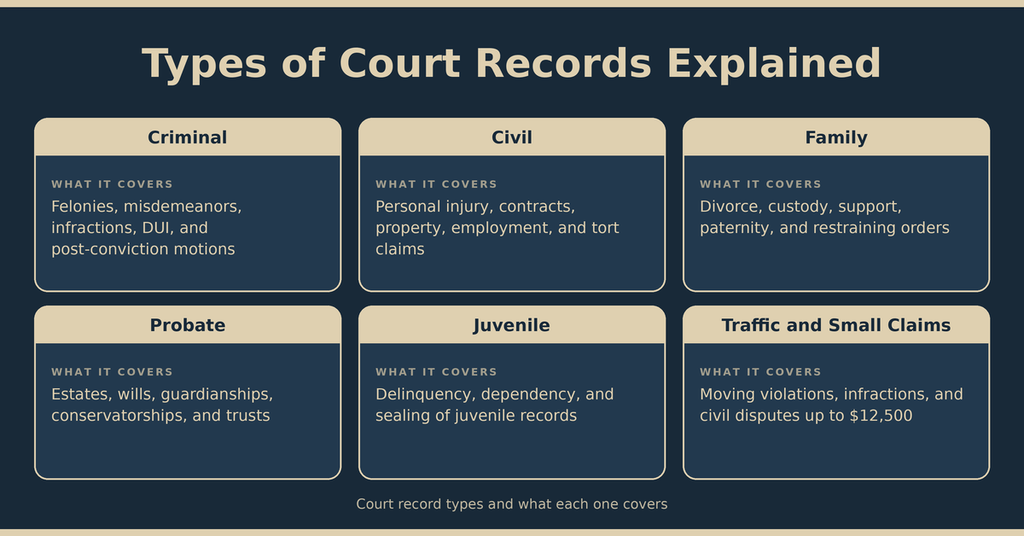
Sacramento County Court Records fall into several major categories, each covering a different area of law. The type of case controls which court hears the matter, which documents get filed, and which records are public. The online portal separates cases by type so you can filter your search. You can request certified copies of any public record type, but some documents are restricted or sealed by law. The table below lists the main record types in the county and what each one covers.
Criminal Court Records
Criminal court records cover cases where the state charges a person with a crime. Sacramento County handles felonies, misdemeanors, and infractions at the criminal courthouse. These records show the charges, plea, verdict, sentence, probation terms, and any appeals. Most criminal records are public after the case closes, but some details stay sealed, such as juvenile charges, sealed dismissals, and certain sex offense registrations. You can search criminal records by defendant name or case number on the official portal.
Civil Court Records
Civil court records cover disputes between people, businesses, or government agencies. Sacramento County civil courts handle personal injury, contract disputes, property cases, medical malpractice, and employment claims. These records show the complaint, answer, motions, discovery, and final judgment. Civil cases often take longer to resolve than criminal cases, so the case history may span several years. You can search civil records by party name, case number, or filing date on the portal.
Family Court Records
Family court records cover cases involving marriage, children, and domestic relations. Sacramento County family courts handle divorce, legal separation, child custody, child support, spousal support, paternity, and domestic violence restraining orders. These records include petitions, responses, custody evaluations, and final judgments. Some family records are sealed, especially those involving child custody evaluations, adoption, or juvenile dependency. You can search family records by party name on the official portal.
Probate Court Records
Probate court records cover cases involving the estates of deceased people, guardianships, conservatorships, and trusts. Sacramento County probate courts handle wills, estate administration, and mental health conservatorships. These records show the petition, inventory, accountings, and final distribution of assets. Some probate records are sealed to protect the privacy of minors, disabled adults, or sensitive financial data. You can search probate records by the deceased’s name or the case number.
Juvenile Court Records
Juvenile court records cover cases where a minor is charged with a crime or is the subject of a dependency petition. Sacramento County juvenile courts handle juvenile delinquency and dependency cases. These records are highly restricted under California law and most are not available to the public. Limited details may be shared with the minor’s parents, attorneys, law enforcement, and the probation department. Sealed juvenile records may be opened only by court order.
Other Court Records
Other court records in Sacramento County include traffic, small claims, unlawful detainer, mental health, and appellate records. Traffic cases cover moving violations and infractions. Small claims cases cover disputes up to $12,500. Unlawful detainer records cover eviction filings. Mental health records cover conservatorship and LPS cases. Appellate records cover appeals from lower courts. You can search most of these record types on the official portal using the same filters as other cases.
Documents Found in Court Records
Court records contain a wide range of documents filed by parties, attorneys, and the court itself. Each document type has a specific role in the case, from starting the action to resolving it. The Sacramento County online portal lists the document title, filing date, and party who filed it. You can view most public documents for free, but downloading or printing may carry a small fee. The table below shows the most common document types you will find in a case file.
Complaints and Petitions
Complaints and petitions are the documents that start a new case. A civil complaint states the plaintiff’s claims against a defendant. A criminal complaint charges a person with a specific crime. A family petition requests a divorce, custody, or support order. A probate petition asks the court to appoint an executor, administrator, or guardian. These documents show the legal basis for the case and what the filer wants the court to do.
Answers and Responses
Answers and responses are the opposing party’s reply to the complaint or petition. In a civil case, the defendant files an answer admitting or denying each allegation and raising defenses. In a family case, the respondent files a response. In a criminal case, the defendant enters a plea of guilty, not guilty, or no contest. The answer or response shapes the rest of the case and lists any counterclaims or affirmative defenses.
Motions
Motions are written requests asking the court to take a specific action in a case. Common motions include motions to compel discovery, motions to dismiss, motions for summary judgment, motions to reduce sentence, and motions to seal records. Each motion is filed by a party, served on the other side, and scheduled for a hearing. The court issues a written order ruling on the motion. You can view motions and their orders on the case detail page.
Court Orders
Court orders are written rulings issued by a judge that direct parties to act or stop acting in a certain way. Orders may be routine, like a scheduling order, or final, like a judgment. They cover matters such as temporary custody, protective orders, search warrants, and sentencing. Sacramento County Court Records show each order with the date, the judge who signed it, and a short description. Orders are public unless the court seals them.
Notices
Notices are filed documents that inform parties and the court of hearings, filings, or other events. Common notices include notices of hearing, notices of motion, notices of entry of judgment, and notices of appeal. A notice tells the other party when and where to appear, or what document was filed. Notices help track the schedule and procedural steps of a case. The online portal lists each notice on the case docket with the filing date.
Judgments
Judgments are the final written decisions of the court that resolve a case. A judgment in a civil case awards money, orders specific performance, or dismisses the case. A judgment in a criminal case imposes a sentence after a guilty plea or verdict. A judgment in a family case grants a divorce, custody, or support order. The judgment is the last entry in most case files and triggers appeal deadlines. You can request a certified copy of the judgment from the clerk.
Filed Exhibits and Attachments
Filed exhibits and attachments are documents attached to a motion, petition, or other filing to support the party’s argument. Common exhibits include contracts, photographs, medical records, police reports, and declarations. The court may consider these exhibits when ruling on a motion or at trial. You can view exhibits on the case docket, but some may be restricted if they contain sensitive data, sealed records, or confidential personal details. Restricted exhibits are only available by court order.
Court Proceedings and Case Outcomes
Court proceedings are the hearings, trials, and other events that move a case from filing to final resolution. Each proceeding leaves a record in the case file, including the date, type, judge, and outcome. The Sacramento County online portal lists the full event history, so you can see every step in the case. Tracking proceedings helps you follow the timeline, prepare for upcoming events, and see how the court reached its final decision. The next sections explain the main proceeding types and case outcomes you will see.
Hearings and Proceedings
Hearings and proceedings are scheduled court events where the judge hears arguments, reviews motions, or takes testimony. Common hearings include arraignments, pretrial conferences, motion hearings, status conferences, and sentencing hearings. Each hearing is listed on the case docket with the date, time, courtroom, and outcome. You can attend most public hearings in person or watch them online when the court offers live streaming. The minutes or transcript of the hearing may be available for a fee.
Trial Information
Trial information covers the events of a jury trial or bench trial, including jury selection, opening statements, witness testimony, closing arguments, and the verdict. The trial date is set after the court holds a final readiness conference. Sacramento County tries both civil and criminal cases at the Main Courthouse and the Carol Miller Justice Center. The trial may last a few hours, a few days, or several weeks, depending on the case. The verdict and judgment are entered into the record after the trial ends.
Settlements
Settlements are private agreements between parties that resolve a case before trial or judgment. In a civil case, a settlement may involve payment of money, return of property, or agreed terms on a contract. In a family case, a settlement may set custody, support, and property terms. Settlements avoid the cost and risk of trial. The court enters the settlement as a stipulation and judgment, so the terms become part of the public record.
Dismissals
Dismissals end a case before a final judgment on the merits. A case may be dismissed because the plaintiff drops the action, the parties reach a settlement, the court grants a motion to dismiss, or the statute of limitations has passed. Criminal cases may be dismissed for lack of evidence, witness issues, or improper procedure. A dismissal with prejudice bars the same claim from being refiled. A dismissal without prejudice leaves the door open for a new filing.
Judgments and Final Dispositions
Judgments and final dispositions are the official outcomes of a case after all hearings, trials, and rulings. A judgment states who wins and what relief is granted. A final disposition shows the case is fully resolved. For criminal cases, the disposition lists the plea, verdict, and sentence. For civil cases, the disposition lists the prevailing party and any money or injunctive relief. The final disposition closes the case in the court’s system.
Case Closure
Case closure is the final step in the life of a court record. Once all judgments, sentences, and post-trial motions are resolved, the clerk marks the case as closed. A closed case is archived and moved to long-term storage, including family court records, but the record remains available for viewing or certified copy requests. Some closed cases may be reopened if a party files a post-conviction motion, a civil judgment debtor files an appeal, or a family case needs enforcement of an order.
Sacramento County Court Records Public Access
Public access to Sacramento County Court Records is governed by California law and the rules of the Superior Court. Most court records are open to the public, but the law limits access to certain categories to protect privacy, safety, and the integrity of the court process. The online portal is the fastest way to view public records, but you can also visit the clerk’s office for in-person help. The list below shows the main public access items and what each one covers.
- Public case details: name, case number, court, judge, filing date, status, and disposition
- Online records: full portal with search filters and document downloads
- Public documents: complaints, motions, orders, judgments, and notices
- Records by request: archived files, offsite records, and certified copies
- Restricted records: sealed files, juvenile cases, and protected data
Public Case Details
Public case details are the basic data that anyone can view about a Sacramento County case. This includes the case number, party names, court location, judge, filing date, case type, case status, and disposition. You can see this data on the online portal without registering or paying a fee. Public case details let you confirm a case exists, track its progress, and check the outcome. The data is updated each business day by the clerk’s office.
Online Court Records
Online court records cover the full set of public case data and documents available through the Sacramento County portal. The portal is free to use, available 24 hours a day, and works on desktop and mobile browsers. You can search by party name, case number, filing date, court, or case type. Most public documents, including complaints, motions, and orders, can be viewed for free. Certified copies and printed copies carry a fee.
Public Documents
Public documents are the filings, orders, and judgments in a case that are open to view. The clerk’s office adds documents to the online portal as they are filed and processed. Common public documents include complaints, answers, motions, declarations, orders, and judgments. You can click each document on the docket to view a scanned image or PDF. Some documents may take a few days to appear online if the clerk is still processing them.
Restricted Details
Restricted details are data the court keeps out of public view to protect privacy, safety, or the legal process. Common restricted items include social security numbers, financial account numbers, minor children’s names in some family cases, and home addresses of certain protected parties. The clerk redacts restricted data before posting records online. You can request unredacted copies only with a court order or a specific legal basis.
Sealed Records
Sealed records are entire case files or specific documents that a judge has ordered kept from public view. A judge may seal a record to protect a victim, a witness, a trade secret, or a juvenile. Sealed records do not show up in public searches. You cannot view, copy, or request a sealed record without a court order. Common sealed cases include juvenile dependency, certain family law matters, mental health cases, and cases involving undercover officers.
Juvenile Record Restrictions
Juvenile record restrictions are special rules that limit who can view a minor’s case file. Under California Welfare and Institutions Code, most juvenile records are confidential. The minor, the minor’s parents or guardians, attorneys of record, the probation department, and law enforcement can view a juvenile record. Other people must ask the court for permission. Many juvenile records can be sealed or destroyed when the minor turns 18 and meets the legal requirements.
Records Available by Request
Records available by request are public records that are not posted online or that need extra steps to get. Some older records, archived files, and large document packets are stored offsite and must be pulled by the clerk. You can request these records in person, by mail, or by email. The clerk will let you know the fee and the time needed to retrieve the file. You can view the records at the clerk’s office or order certified copies for a fee.
Obtaining Official Court Records
You can get official Sacramento County Court Records in three main ways: through the online portal, by contacting the court clerk, or by visiting the clerk’s office in person. Each method works for different needs, from quick online lookups to certified copies for legal filings. The clerk’s office is the only source for certified copies, which carry the court’s official seal and are accepted by other courts and government agencies. The list below shows the main request methods and what each one is best for.
- Online requests: best for quick lookups and digital copies
- Court clerk requests: best for archived or offsite records
- In-person requests: best for certified copies and same-day pickup
- Mail requests: best for out-of-town users and large document packets
- Email requests: best for simple record lookups and small fees
Online Requests
Online requests let you pull up public records, view documents, and request certified copies through the Sacramento County portal. You can search for cases, view docket entries, and download PDF copies of public filings. To request a certified copy online, you add the document to your cart, pay the fee, and pick a delivery method. The portal accepts major credit and debit cards. Online requests are processed during regular business hours and sent by mail or made available for pickup.
Court Clerk Requests
Court clerk requests let you ask the clerk’s office for records by phone, email, or mail. You provide the case number, party name, and the documents you need. The clerk confirms the request, tells you the fee, and prepares the records. This method works well for archived files, large document packets, or records that are not yet online. You can pay by check, money order, or credit card, depending on the clerk’s office rules.
In-Person Requests
In-person requests let you visit the clerk’s office and view or copy records on the spot. The Sacramento County clerk’s office is open Monday through Friday from 8:30 AM to 4:00 PM, except court holidays. You can use the public terminals to search the case database, view scanned documents, and print what you need. The clerk’s staff can help you locate cases, pull archived files, and order certified copies during your visit.
Certified Copies
Certified copies are official copies of court records that carry the court’s seal and the clerk’s signature. Other courts, government agencies, employers, and licensing boards often require certified copies. You can order certified copies in person, by mail, or online through the portal. Each certified copy costs a set fee plus any retrieval or copying charges. The clerk marks the document as a true copy of the original court record.
Copy Fees
Copy fees cover the cost of retrieving, copying, and certifying court records. Sacramento County charges a fee for each page copied, a fee for certification, and a fee for searches that take extra time. The clerk’s office posts the current fee schedule on its website and at the public counter. You can pay by cash, check, money order, or credit card, depending on the request method. The clerk will tell you the total cost before processing the request.
Processing Times
Processing times for record requests depend on the method you use and the type of record. Online portal requests are usually processed the same day for documents that are already scanned. Mail and email requests can take 5 to 10 business days, depending on volume. Archived records stored offsite may take 2 to 4 weeks to retrieve. Certified copy requests take the same time as regular copy requests, plus the time to add the court seal and signature.
Court Record Accuracy and Availability
Sacramento County Court Records are kept as accurate and current as possible, but a few factors can affect what you see in a search. The clerk’s office updates the system each business day, so very recent filings may not yet be online. Older cases may be stored offsite and take time to retrieve. Some records are missing pages, redacted, or marked as archived. The next sections explain how to verify a record, confirm the right party, and handle cases that are not in the system.
Verifying the Correct Case
Verifying the correct case starts with matching the party name, case number, and filing date to the person you are researching. Always compare the full name, date of birth if available, and the case type. People with similar names can appear in the same search results, so take an extra moment to confirm you have the right file. The case number, judge, and court location are the strongest details to confirm. Cross-check the data before you use the record for legal, business, or personal reasons.
Matching Party Names
Matching party names takes care when the same name shows up for more than one person. Sacramento County records may show the full legal name, an alias, a former married name, or a business name. Add a middle name, date of birth, or address if you have them. Look at the case type and filing date to rule out unrelated cases. If you still see too many results, narrow your search to a single court or a short filing date window.
Confirming Case Numbers
Confirming case numbers is the fastest way to be sure you have the right case. The case number stays with the file for the entire life of the action, even if the case moves between departments. A case number that starts with the right year code and case type code is almost always the correct file. If a case number does not return any results, double-check for typos, dashes, or extra spaces. You can also search by the party name and look for the matching case number on the docket page.
Recently Filed Cases
Recently filed cases may not show up in the online portal right away. The clerk’s office needs time to enter the case into the system, scan the first filings, and assign a judge. New cases often appear online within 1 to 3 business days of filing. Some filings take longer if the case is complex or has many initial documents. If you cannot find a very recent case, wait a few days and search again, or call the clerk’s office for help.
Delayed Record Updates
Delayed record updates can affect what you see in a search, especially for older or large cases. The clerk’s office updates the docket each business day, but some events take longer to enter. Motions, exhibits, and orders may be processed in batches. If a recent ruling or filing is missing, check back in a few days. The clerk’s office can also confirm the date a specific document was added to the system.
Missing Documents
Missing documents can happen when a filing is still in process, when a document is sealed, or when a record is stored offsite. The online portal may show a docket entry with no linked document, which usually means the document is being scanned. Some documents are sealed by court order and never appear online. Older paper records may be archived and need a special request to view. The clerk’s office can tell you why a document is missing and how to get a copy.
Archived Records
Archived records are older case files moved to long-term storage after the case is fully closed. Sacramento County archives records after a set number of years, often 5 to 10 years after closure. You can still request archived records, but retrieval may take longer and may carry an extra fee. The clerk’s office can pull the file, scan the documents, or send you certified copies. Some very old records may have been destroyed under retention rules, so the file may no longer exist.
Court Records Search Problems
Even with a strong search system, a few common problems can stop you from finding the Sacramento County Court Records you need. Most problems come from small errors in the search, a sealed or restricted file, or a recent filing that is not online yet. The next sections cover the most common search issues and what you can do to fix them. You can also call the clerk’s office at (916) 874-5522 during business hours for help with a specific case.
Case Not Found
A “case not found” message means the system did not match your search terms to any record. The most common causes are a typo in the name, a wrong case number, a wrong year, or a sealed record. Try a broader search by using only the last name, or remove the case number and search by party name and filing date. You can also switch the search to a different court or case type. If you still cannot find the case, call the clerk’s office for help.
Incorrect Party Name
An incorrect party name is one of the most common reasons a search returns no results or the wrong file. People often use a nickname, a married name, or a different spelling than the one on the court file. Try other versions of the name, including former names and aliases. The court records use the legal name on the filing, so the exact match matters. Adding a date of birth or middle name can help you find the right person.
Incorrect Case Number
An incorrect case number can stop a search cold. The case number must match the file exactly, with the right year code, case type code, and sequence number. A single typo, a missed digit, or an extra space will return no results. If you do not have the full case number, search by party name and find the matching case number on the result page. The portal will then let you open the full record with one click.
Wrong Court or Jurisdiction
A wrong court or jurisdiction can happen when a case is filed in a different county or moved to a different court. Sacramento County only has records for cases filed in its own courthouses. Cases filed in other California counties are kept in those counties’ portals. If the case was moved on appeal, the record may be in the California Court of Appeal or the California Supreme Court. Make sure you are searching the right court before you request certified copies.
Missing Documents
Missing documents can occur when a filing has not been scanned, a document is sealed, or the record is archived. The online portal may show a docket entry with no linked PDF, which means the document is still being processed. Sealed and restricted documents never appear in public view. Archived records need a special request to view. The clerk’s office can tell you the status of a missing document and how to get a copy when the file is available.
Restricted or Sealed Records
Restricted or sealed records do not show up in public searches. The court seals records to protect victims, juveniles, undercover officers, and trade secrets. You cannot view, copy, or request a sealed record without a court order. If you have a legal reason to see a sealed record, you can file a motion to unseal. The court will hold a hearing and decide whether to open the file. Some records stay sealed forever under state law.
Outdated Case Information
Outdated case information can show up in third-party sites that copy public records and do not update them. Always rely on the official Sacramento County portal for the most current data. The clerk’s office updates the system each business day, so the official portal has the latest filings, rulings, and dispositions. If you see a difference between two sources, trust the official portal and contact the clerk’s office if you need to confirm a specific detail.
Contact Details
You can reach the Sacramento County Superior Court clerk’s office for help with court records, certified copies, and search questions. The clerk’s office is open Monday through Friday from 8:30 AM to 4:00 PM, except court holidays. You can call, visit in person, or use the official online portal. The contact details are listed in the table below.
Frequently Asked Questions
Find quick answers about locating and using Sacramento County court records.
How can I search Sacramento County court records online?
Visit the Superior Court of California, County of Sacramento case‑search portal at the official website. The site is free and does not require an account. Enter a party name, case number, or filing date to retrieve details. Results include case type, status, and basic docket information. The portal works on computers and mobile devices. For help, call the clerk’s office at (916) 874‑5522 during business hours.
What information appears in a Sacramento court case lookup?
A lookup shows the case number, parties involved, filing date, and current status. It also lists the court where the case is filed, the type of case—such as criminal, civil, family, or probate—and any recent actions recorded. Some entries may display basic docket entries like motions or orders. Sensitive details are hidden if the record is sealed or restricted.
Can I find criminal case status through the public portal?
Yes. The online search includes criminal matters filed in Sacramento County. After entering the defendant’s name or case number, the system displays whether the case is open, pending, dismissed, or closed. It also shows recent court actions, such as hearings or judgments. If a case is sealed, the portal will not reveal its contents.
How to request certified copies of court records?
Contact the Sacramento County Clerk’s Office by phone or in person. Provide the case number, parties’ names, and specify the documents you need. The clerk will verify your request, calculate any fees, and process the order. Certified copies are mailed or available for pickup during office hours. Expect a short processing time, especially for recent filings.
Why a case might not show in the search results?
Several reasons can keep a case from appearing. The record may be sealed, restricted, or still being entered into the system. Incorrect or incomplete search terms, such as a misspelled name or wrong case number, also cause missed results. Finally, very recent filings might take a few days to appear in the public database.